The Middle of the Court
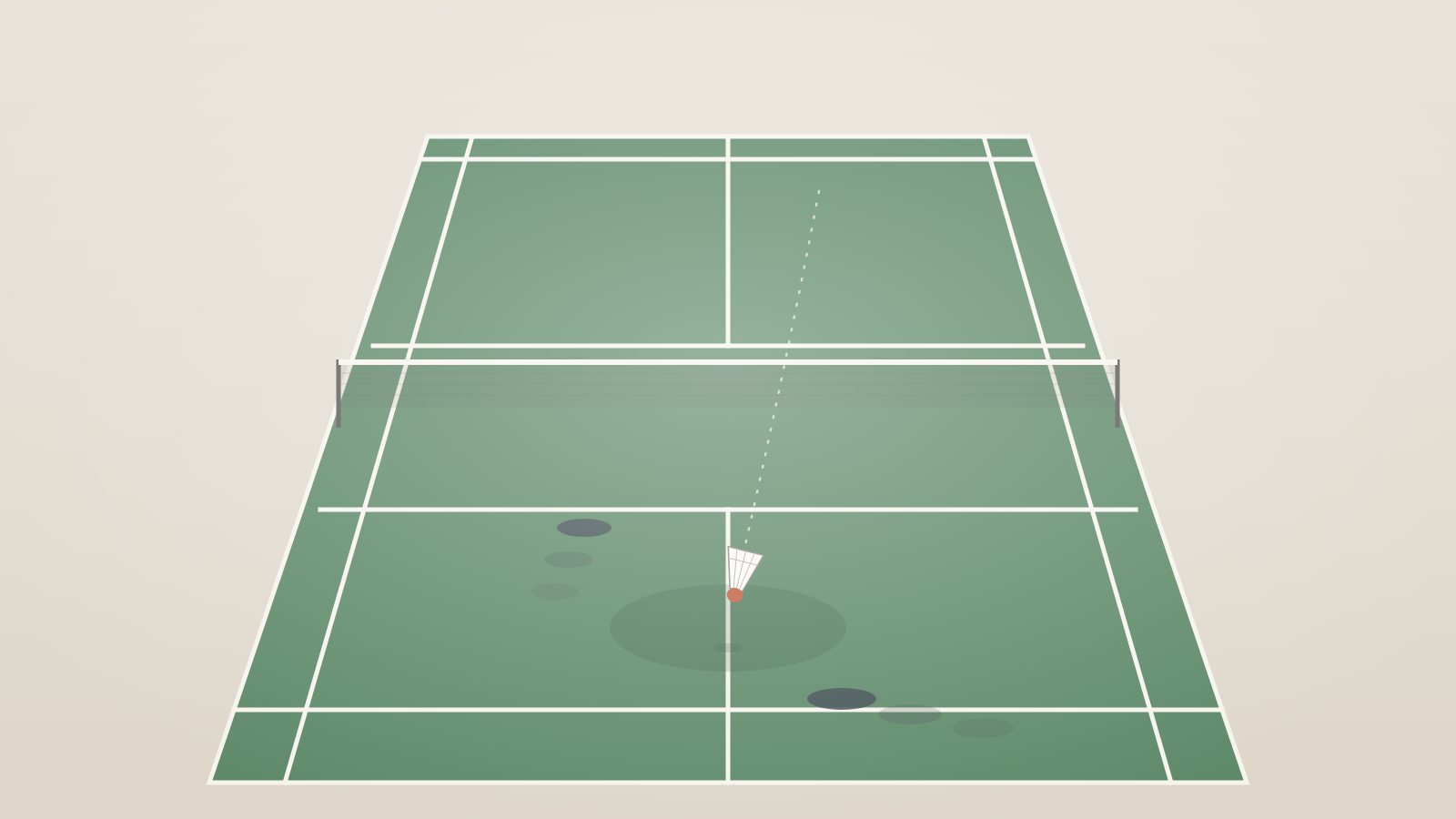
There’s a shot good opponents love to play in doubles. It goes down the middle, a little behind both of us, into the strip of court that belongs to no one in particular. For maybe half a second the shuttle hangs there, and two people have to make the same decision at the same time without a word passing between them.
When it goes right, nobody notices. One of us takes it, the other is already sliding into the space they left behind, and the rally carries on. When it goes wrong, you get the familiar comedy: two rackets clacking together, or both of us stepping back politely and watching the shuttle land between our feet.
I play most days, and doubles is where I’m strongest. Not because I hit harder than anyone, but because I’ve spent a lot of hours learning what that half second asks of you. Mostly, it asks you to trust that the other person is there.
The hardest habit to unlearn, early on, was helping too much.
You see a weak return heading toward your partner’s side and you think, I can get that. Sometimes you can. But the moment you drift across to cover it, you’ve left your own half open, and you’ve told your partner something they didn’t need to hear: that you weren’t sure they’d manage. Do it a few times and they start hesitating. They reach for shots a fraction late, half expecting you to arrive. Now you’re both covering the same metre of court and nobody is covering the rest.
I used to think of that as generosity. It took me a while to see it for what it usually is. Over-helping on a badminton court is mostly distrust wearing a nicer coat. The most useful thing I can do for my partner is hold my own space well, so they never have to wonder about it.
People who don’t play assume good doubles pairs talk constantly. Some do call “yours” or “mine,” and there’s a place for that. But a fast rally doesn’t leave room for explanation. By the time you’ve said “you take the back,” the shuttle has already been and gone.
So you learn to read instead. Where your partner’s weight is sitting. Whether their racket is up or down. The small split step that tells you they’re ready to move, and which way. When my partner plays a tight net shot and keeps drifting forward, I know I’m at the back now, and I’m moving before I’ve consciously thought it. The front-and-back rotation, done well, has a rhythm to it, almost like two people breathing in turns.
I think this is why the game feels so familiar to me. In retail training I spend a lot of time watching how people stand when they’re unsure, how a new team member’s shoulders change once they’ve found their footing. Reading tarot is attention of a different kind, but it’s still attention: to what a person isn’t saying, to where their eyes go when a card turns over. On court it’s the same muscle. You watch. You let the body tell you what words would arrive too late to say.
Then there are the mistakes, which are constant, because it’s badminton.
What I’ve come to care about most is the three seconds after one. Your partner nets an easy lift, or swings at a smash that isn’t there. They walk back to position, and in that short walk you have a choice. You can sigh. You can offer a quick bit of advice, “watch the wrist,” which they didn’t ask for and already know. Or you can catch their eye, nod, and get ready for the next point.
The sigh and the advice feel small, but they’re expensive. I’ve watched them cost a pair the next two points more times than I can count. The person who made the error is now playing to avoid another one rather than to win the rally, and tight players make worse decisions. The nod costs nothing. It just says: still here, still us. The court resets.
I notice the same patterns off the court more than I’d like to admit.
The colleague who quietly redoes your part of the project, meaning well. The friend who fills every silence with reassurance, so you never get to just sit in it. The moment after someone gets something wrong at work, when the whole room waits to see whether the response will be a sigh or a nod. The partnerships I value most, at work and away from it, have the feel of a good rotation. Each person holding their ground. A lot of reading, not much announcing. Recovery that happens quickly and without ceremony.
I don’t think badminton taught me this so much as made it visible. It’s hard to pretend on a court. Your trust, or the lack of it, shows up in where you stand.
Last week, late in a long game, the shuttle came down the middle again, into that same grey strip. I didn’t call it and neither did my partner. They went for it, and I was already moving to fill the gap they’d left. The rally went on for another eight or nine shots, and we lost it in the end.
Walking back, they glanced over. I nodded. We set up for the next one.